Products that make
work simpler.
We build software around the processes an organisation already runs — connected to the tools it already uses, with AI brought in where it removes effort. Servanda, for resource and work management, is the first.
We build products, not another dashboard
To make an organisation's processes easier — by building products around the work people already do, and bringing AI in where it genuinely removes effort rather than adding a step.
We build products
Not one-off projectsEach product starts from a process that teams already run by hand, and is built to carry that process end to end rather than add another tool beside it.
We integrate, not isolate
Your existing stack staysOur products connect to the calendars, inboxes, trackers and chat tools an organisation already depends on, so adopting one does not mean replacing what works.
We bring AI in where it earns its place
Judgement stays with peopleAI handles the reading, summarising and chasing that costs teams their week. Decisions, approvals and anything consequential stay with the people accountable for them.
Servanda is live today
Our first product, for resource and work management. More are on the way.
What we have built so far
One product live today, each with its own home. More are in the works.
Servanda
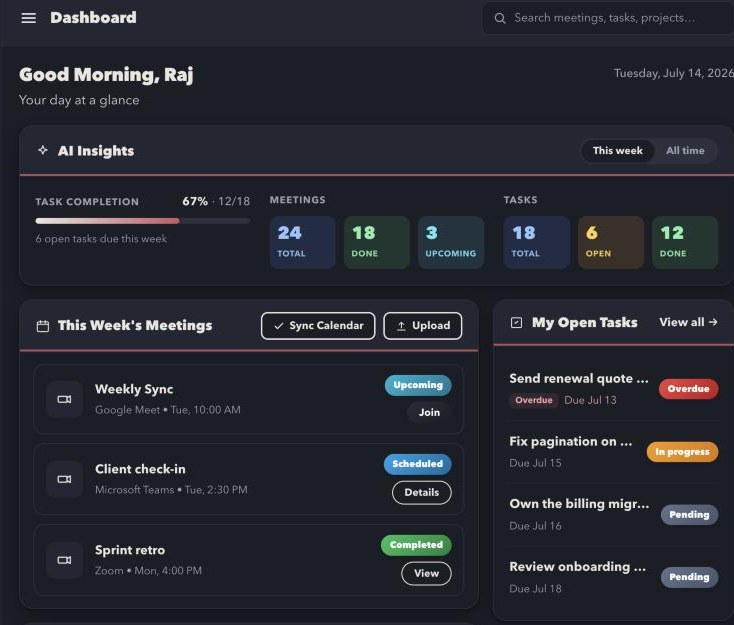
Every meeting, message and ticket becomes tracked work — that chases its own status.
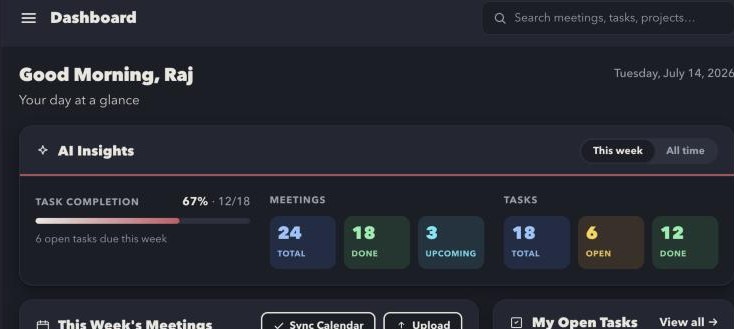
Servanda is the organisation-wide hub for managing work and resources. It captures action items from meetings, email, Slack, Teams, Jira and Asana into one list, then nudges owners and escalates to managers on a schedule you set.
- Meetings
- Tasks
- Reports
The next products
We build in the same direction each time: take a process an organisation already runs by hand, carry it end to end, and connect it to the tools already in use.
If there is a process in your organisation that costs more effort than it should, we would like to hear about it.
The same principles behind everything we ship
Whatever the product, these do not change. They are how we decide what to build and what to leave out.
Enterprise Grade Trust & Privacy
Your company data is isolated in dedicated cryptographic containers.
The kind of problem a product should absorb
Four situations our products are built around, and how each one is approached.
Commitments made in a meeting that nobody has to transcribe
Action items are agreed out loud, written into someone's notes, and quietly lost between the call ending and the next one starting.
Servanda joins the meetings you allow, produces a summary and a structured transcript, and turns each action item into an assigned task with the owner resolved by name and email.
The same task raised in two tools, counted once
A request arrives as a Jira ticket and again as a Slack message, so two people track it and neither is sure which is current.
Both resolve to one task tagged by source, with a link back to each origin. Re-syncing does not create a second copy.
Status updates that do not need a status meeting
A manager spends the week asking for updates, and the answers arrive in five different threads.
Owners are nudged on a set schedule. Work with no update turns overdue and escalates, and the manager gets a rollup across direct reports instead of a round of questions.
Capture that does not mean handing over the inbox
Pulling work out of email usually means granting a tool full mailbox access, which most teams are not willing to do.
Email capture is forward and CC only by default. Wider access is a separate, explicit opt-in, and auto-detected tasks land in a review lane that someone accepts or dismisses.
Processes are where the
effort quietly goes.
We build products that take that effort off your team — starting with Servanda.